Heading to ClioCon Oct 26-27?
Meet LegalMate in Boston
Heading to ClioCon Oct 26-27?
Meet LegalMate in Boston
Heading to ClioCon Oct 26-27?
Meet LegalMate in Boston
Heading to ClioCon Oct 26-27?
Meet LegalMate in Boston
Heading to ClioCon Oct 26-27?
Meet LegalMate in Boston
Heading to ClioCon Oct 26-27?
Meet LegalMate in Boston
Oct 26, 2026
What we know (and don’t) about Clio Phones after ClioCon 2026
Clio announced Clio Phones at ClioCon on October 26, 2026. What it does, what it costs, when it ships, and whether your firm should switch phone systems.

By Danial Alam, LegalMate. Last updated October 26, 2026. I will update this post every time Clio publishes something new about Clio Phones: pricing, ship date, Canada, porting, desk phones, data policy.
In short
Clio Phones is a business phone system built into Clio, announced at ClioCon in Boston on October 26, 2026. Incoming calls show the client and matter, calls can be recorded, transcribed and summarized, and the results attach to the matter with time entries prepared for review. It is built on Corvum, a legal VoIP provider Clio acquired.
Clio has not published pricing. Clio Phones is available for trial in select US states now, with wider availability "coming soon" per Clio's press release, and the unified Clio interface it lives in is slated for November. Corvum's last listed price was $29.95 per user per month.
You do not have to switch phone systems to get AI call notes, matter matching and time entries in Clio. Firms on Dialpad, RingCentral, Zoom Phone or Quo can add that layer to the system they already pay for. I cover both paths below.
What Clio Phones is
Clio Phones is an AI-native business phone system built directly into Clio. Clio announced it on October 26, 2026 at ClioCon as part of a new unified platform that puts Clio Grow, Manage and Work in one interface. It is the first time Clio has sold a phone system rather than integrating with one.
According to Clio's press release and Legal IT Insider's coverage, Clio Phones does four things:
Surfaces the relevant client and matter information when a call comes in.
Records, transcribes and summarizes calls.
Attaches the call record to the appropriate client or matter.
Prepares time entries for review.
The press release adds the telecom basics: firms can set up a new business number or transfer an existing one, assign lines to attorneys and staff, and route incoming calls to wherever the team is working. Transcripts and summaries are generated "with recording enabled," and the prepared time entries capture the duration, date and description of each call. Clio also cites its own survey of firms: an average of three hours a week on post-call administration and 4.6 billable hours a month lost to unlogged call time.
Clio describes the result as information flowing both ways: what Clio already knows about the matter informs the conversation, and what is said on the call becomes available for the work that follows.
Clio Phones launched alongside a unified inbox for email and text, in-person meeting recording in Clio Mobile (with permission), a document management system called Documents Pro, Clio Docket for court monitoring, Vincent Projects for shared AI work, and agentic workflows across Grow, Manage and Work. Those are covered briefly at the end. Everything else here is about the phone system.
What the keynote demo showed
Clio's keynote walked through a single matter, a power of attorney petition for a client named Salvatore Marchetti, brought by his daughter Beth. The phone portion ran in five steps on screen:
Caller recognized. Beth's number matched an existing contact, and the call screen opened with the matter summary beside it: stage, practice area, responsible attorney, trust balance and outstanding balance.
Gives consent. A distinct step in the flow, shown before any recording began.
Call recorded.
Call transcribed.
Summary saved. A few sentences in plain English, attached to the matter.
Two details stood out. The call window carried the line "If recorded, this call will be auto-transcribed and summarized," which suggests recording is a per-call choice rather than always on. And consent was given equal billing with recording and transcription, which matches where bar guidance has landed (see the consent section below).
The demo also showed an after-hours call at 9:40 pm answered by a "lead screening agent" that ran intake, checked conflicts and booked a consult by text. That is Clio Grow's AI voice agent, not Clio Phones. The two get confused, so there is a section on the difference further down.
Is Clio Phones the same as Corvum?
Clio Phones is built on Corvum, a cloud VoIP platform built for law firms that had been in Clio's app directory since 2020. Clio's own job posting for a General Manager of Phones describes the acquisition and calls the role "a build role": the product, team and installed base exist, but pricing architecture, a repeatable attach motion, a support model and a forecast do not yet.
What Corvum offered before the acquisition, from its Clio app directory listing and FAQ:
From $29.95 per user per month (USD), month to month, with numbers, recording, texting and minutes included.
Two-way contact and matter sync with Clio, communications and time-entry sync, and an AI call summary posted to the Clio communications log.
Mobile, web and desktop apps, plus desk phones (Polycom recommended). Microsoft Teams calling supported.
Number porting in about five business days, with express porting at extra cost.
SMS and MMS logged to Clio (attachment titles only).
Bilingual support. Operated in the US and Canada.
Voicemail transcription listed as "in development."
Lawyerist rated Corvum 4.5 out of 5, citing built-in texting, call tracking and the Clio integration as strengths, and few integrations, cost and no video as weaknesses. Community reviews from 2021 to 2023 mentioned call quality, app login problems and the price of add-on users and numbers.
Why this matters: Clio Phones is not a new network. It is an established legal VoIP provider with Clio's AI layer on top. The questions to ask are ordinary telecom questions (porting, desk phones, 911, call quality, price per seat), and many Clio users have never had to ask them because their phone vendor handled it.
How much does Clio Phones cost?
Clio has not published Clio Phones pricing as of October 26, 2026. Three data points while we wait:
Corvum's last listed price was $29.95 per user per month, month to month.
Clio's job posting says the pricing architecture for Phones is still being built, and the Clio Phones page currently offers a demo request rather than a price.
Clio Grow's AI voice agent, a separate product, is priced per converted lead at $25, with the first three free. That is a usage model, not a seat model, and there is no indication Phones will follow it.
I will update this section the day Clio publishes a number. If you are modeling a switch now, the honest comparison is Corvum's seat price against whatever you currently pay per user for Dialpad, RingCentral, Zoom Phone or Quo, minus any integration or connector fees you would drop.
When is Clio Phones available?
Clio's press release says Clio Phones "is now available for trial in select U.S. states, with wider availability coming soon." Clio has not named the states or given a general availability date. The unified Clio interface it belongs to is "available in November," per Legal IT Insider. If you want in early, the Clio Phones demo page is the only route Clio has published.
Regions: Corvum operated in the US and Canada, and Clio's GM posting references the FCC, CRTC, 911 and porting, so expect both countries. No mention of the UK, EU or Australia.
What we know and what we don't
Known
Clio Phones is a phone system built into Clio, announced October 26, 2026.
Built on Corvum, which Clio acquired.
Features per Clio: caller and matter context on inbound calls, recording, transcription, summaries, attachment to client or matter, time entries prepared for review.
Consent appears as a discrete step in Clio's demo flow.
Available for trial in select US states as of launch day; Clio has not named the states.
Existing numbers can be transferred, per Clio's press release.
The unified Clio interface ships in November.
Separate from Grow AI's voice agent (US only, $25 per converted lead).
Unknown
Pricing, and whether existing Corvum customers keep their rate.
General availability date, which states are in the trial, and rollout order.
Whether it is sold per seat, per firm or bundled into a Clio tier.
Canada availability at launch.
Porting timeline under Clio (Corvum quoted about five business days).
Desk phone and Microsoft Teams support carried over from Corvum.
Whether recording is per call, per user or firm wide, and how consent is captured and stored.
Data retention, deletion, and whether call data is used to train AI.
Whether third-party phone systems will get the same AI features through integration, or whether those stay exclusive to Clio Phones.
*As of Oct 26, 2026 at 12:14PM ET, published on announcement day.
Do you have to switch to Clio Phones to get AI call notes in Clio?
No. You do not need Clio Phones to get call notes into Clio. As of today Clio still supports its integrations with phone providers like Dialpad, Zoom Phone and RingCentral, and nothing in the announcement changes that. With LegalMate, firms on those systems (and Quo) get the call intelligence layer Clio described, AI summaries, matter matching and time entries prepared for review, flowing from the phone system they already use into Clio. Clio Phones is one more way to get there, not the only one.
Should you switch to Clio Phone?
Switching phone systems is a different kind of decision from adding software. It touches your number, your hardware, your contracts and your 911 registration. It also helps to be honest about who a first release is built for. Clio tends to launch new products for solos and small firms first and move up market in later releases, and everything public about Clio Phones so far (a trial in select states, no published seat pricing, a product team still being hired) points to the same pattern. Read the checklist below with that in mind.
Switching probably makes sense if you are a solo or a very small firm and:
You have no business phone system today, or you are running the practice on a personal cell or a consumer plan. This is the clearest win: one number, one bill, calls and notes landing in the matter from day one.
You have one to three lines to move. Porting a handful of numbers is an afternoon; porting a firm's worth of direct lines, fax and toll-free numbers is a project.
You are already a Corvum customer, or your current contract is month to month or ends within the next quarter.
You mostly work from a laptop and a mobile app. If you want a desk phone, plan on a mainstream SIP handset such as Yealink rather than assuming an existing Cisco deployment will carry over.
You want the AI pieces (transcripts, summaries, notes on the matter) without a second vendor, and you are fine being an early customer while pricing and support settle.
Keeping your current phone system probably makes sense if:
You are a firm of roughly ten people or more. Call queues, ring groups, IVRs, multiple offices and an answering service all depend on routing your current system already does well, and those are the features a first release is least likely to match.
You are mid-contract with Dialpad, RingCentral, Zoom Phone or Quo. Early termination fees usually exceed a year of integration costs, and the Dialpad and RingCentral integrations give you the same call record in Clio without the port.
Number porting worries you. It is the step firms most often underestimate, and it is where a switch goes wrong: numbers in limbo, callers hitting dead air, a week of "did you get my message". If you have never ported before, that risk alone is a reason to wait for the general release.
You already use your phone system's AI features (Dialpad AI, RingCentral AI, Zoom AI Companion) for things other than Clio, or you have Microsoft Teams calling or video with the same vendor and do not want to split them.
You run Cisco desk phones, need international calling, SMS campaigns or call center analytics, or you are in Canada and Clio has not confirmed a Canadian date.
You would rather see the price first. Expect Clio Phones to show up as its own line item rather than something folded into your existing Clio plan, and budget accordingly.
Either way, do not decide on features alone. Decide on contract timing, porting risk and what breaks on day one if the switch goes badly.
What we've learned from putting phone calls into Clio
LegalMate is a Certified Clio Partner and moves calls from Dialpad, RingCentral, Zoom Phone and Quo into Clio for firms with 3-4 staff to mid-sized firms. A few things from that work that are relevant to anyone evaluating Clio Phones.
Recording is the easy part. Every modern phone system records and transcribes. The work that saves a firm time is what happens after: matching the call to the right contact and matter when the caller is a parent, a spouse, opposing counsel or a court clerk, writing a summary a lawyer will trust, and producing a time entry that survives billing review. Clio's phrase "time entries prepared for review" is the right design. Fully automatic entries get deleted; prepared entries get approved.
Most firms already have a phone system they chose for other reasons. Across our customer base, roughly two in three firms run Dialpad and one in three run RingCentral, with a smaller group on Quo and Zoom Phone. Most are on annual contracts, and none of them picked their phone system because of Clio. Clio Phones will be an easier sell to firms choosing a phone system for the first time than to firms that already have one.
Call volume is higher than people assume. The median firm we onboard handles around 300 calls a month, and the smallest we have measured was 70. At 300 calls, even a 90-second write-up per call is 7.5 hours of documentation a month. That is the number that makes AI call notes worth having, on any phone system. You can run your own firm's numbers in our billable time calculator.
The failure mode is setup, not software. The most common reason a firm stops using call-to-Clio automation is that they never finished connecting it. Whoever you buy from, Clio included, ask what day-one setup looks like and who does it.
The questions firms ask before they buy. In my demos the questions that decide the deal are not about features. They are: Where is the recording stored and for how long? Can we delete it? Can we restrict sensitive matters so only the responsible attorney sees the transcript? What happens with calls our answering service takes? What about California? Is our client data used to train AI? Our answers are on the security page. Clio will need public answers to all of these for Clio Phones, and I will add them here when it does.
Clio's move validates the category. The largest practice management vendor in the market has decided that the phone call belongs in the matter record, with AI notes and time entries attached. We agree, and have for a while. The question for your firm is which phone system you want underneath that, not whether you want it.
Recording client calls with AI: consent and ethics checklist
Clio's launch materials do not cover this, and it is the first thing a managing partner should settle before any AI phone system goes live. This is a summary of current guidance, not legal advice. Check your own jurisdiction.
AI disclosure: Clio's own help documentation for Grow AI's voice agent tells firms to check their jurisdiction's rules on disclosing that a caller is speaking with AI. Apply the same care to recorded calls.
Checklist before go-live on any AI phone system
Add recording and AI-assisted note-taking language to the engagement letter.
Decide the consent method (verbal notice, written consent, or beep) and document it.
Confirm where recordings and transcripts are stored, the retention period, and the deletion process.
Get the vendor's written answer on whether client data is used to train models.
Set access controls: who can see transcripts on sensitive matters.
Assign a reviewer for AI summaries and time entries before they are billed or relied on.
Handle calls routed through an answering service or AI receptionist separately, since consent may need to happen twice.
Re-check the list of all-party consent states for every office location and for clients who live in them.
Clio Phone vs Grow AI's voice agent: What's the difference?
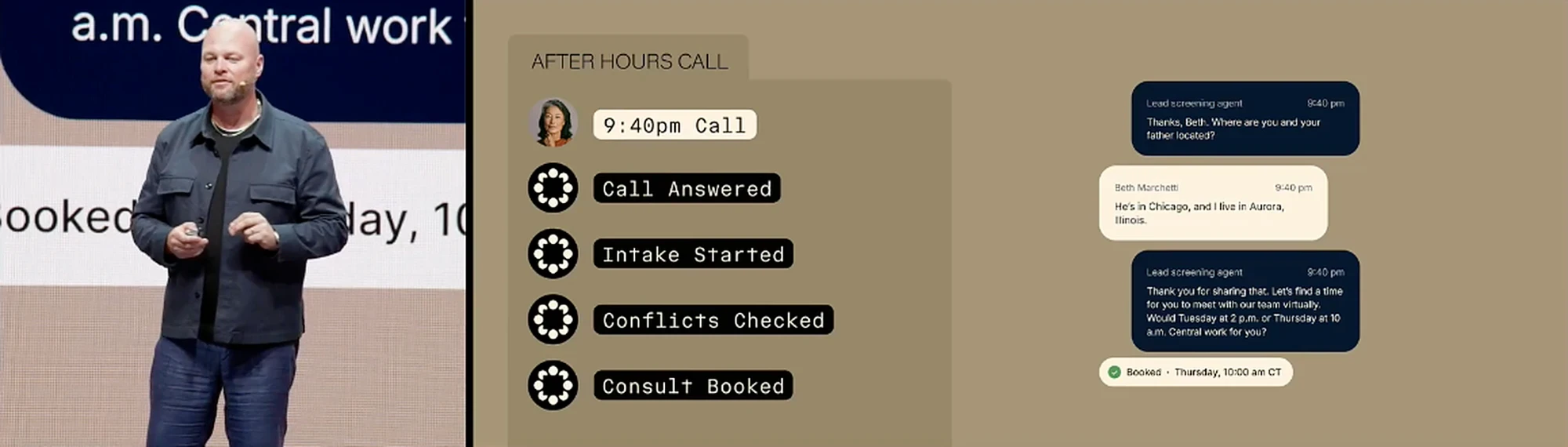
From Clio's ClioCon 2026 keynote, October 26, 2026. The after-hours intake demo is Grow AI's voice agent, not Clio Phones.
Clio launched Grow AI's voice agent in August 2026. It answers calls when staff cannot, screens leads, books consultations and logs a transcript and summary to Clio Grow. It is US only, priced at $25 per converted lead with the first three free, with an optional monthly spending cap. You set it up by forwarding calls from your existing phone system (Clio's help article uses RingCentral as the example) to a Clio number.
Clio Phones is the phone system itself: numbers, lines, calling, recording and post-call documentation for calls your people handle.
So: Grow AI's voice agent answers the phone when you can't. Clio Phones is the phone. Clio Phones does not replace your receptionist or answering service, and Grow AI's voice agent does not record and document the calls your attorneys take. If your firm needs the second part today, that is the LegalMate Clio integration.
Other product updates from Clio Con 2026
For context, since most firms will evaluate Clio Phones alongside these:
Unified interface: one view across Clio Grow, Manage and Work, from intake through billing. Available in November, per Legal IT Insider.
Agentic workflows: Clio's example is assessing a prospective client's inquiry, identifying missing information, preparing a consultation and, after approval, opening the matter. During representation, a new filing can prompt Clio to update the matter chronology and prepare a response.
Unified inbox for email and text messages, logged to the client or matter.
Clio Mobile meeting recording: capture, transcribe and summarize in-person meetings, with permission.
Documents Pro: a full document management system that also handles audio and video, with search, transcription, versioning and access controls.
Clio Docket: US federal and state court filing monitoring.
Vincent Projects: a shared workspace for AI-assisted work across matters.
Legal library: more than one billion primary and secondary legal documents, with daily updates.
Frequently asked questions
What is Clio Phones?
Clio Phones is an AI-native business phone system built into Clio, announced October 26, 2026. It shows client and matter details on inbound calls, records, transcribes and summarizes calls, attaches them to the matter and prepares time entries for review. It is built on Corvum, a legal VoIP provider Clio acquired.
How much does Clio Phones cost?
Clio has not published pricing as of October 26, 2026. Corvum, the platform underneath it, last listed at $29.95 per user per month. I will update this post when Clio announces pricing.
When will Clio Phones be available?
Clio Phones is available for trial in select US states as of October 26, 2026, with wider availability "coming soon" per Clio. Clio has not named the states or given a general availability date. The unified Clio interface it belongs to is slated for November 2026.
Is Clio Phones available in Canada?
Not confirmed. Corvum operated in both the US and Canada, and Clio's hiring materials reference the CRTC, so a Canadian launch is likely but unannounced.
Is Clio Phones the same as Corvum?
Clio Phones is built on Corvum, which Clio acquired. Clio's job posting for the General Manager of Phones describes it as Corvum's product, team and customers brought into Clio with new pricing, sales and support still to be built.
Does Clio Phones record and transcribe calls automatically?
Clio says calls can be recorded, transcribed and summarized "with recording enabled," so recording is a setting rather than a default. In the keynote demo, consent was a distinct step and the call screen stated the call would be auto-transcribed and summarized if recorded, which suggests recording is a per-call choice. Clio has not published the exact controls.
Does Clio Phones create time entries?
Clio says time entries are prepared for review, meaning a person approves them before they are billed.
Can I keep my phone number if I switch to Clio Phones?
Yes. Clio's press release says firms can transfer an existing number. Clio has not published the porting timeline; Corvum quoted about five business days with an express option at extra cost.
Does Clio Phones work with desk phones or Microsoft Teams?
Corvum supported Polycom desk phones and Microsoft Teams calling. Clio has not confirmed whether both carry over.
Does Clio Phones replace my receptionist or answering service?
No. That is Grow AI's voice agent, a separate Clio product that is US only and priced at $25 per converted lead.
Do I have to switch to Clio Phones to get AI call summaries and time entries in Clio?
No. Firms on Dialpad, RingCentral, Zoom Phone and Quo can get call logging, AI summaries, matter matching and time entries in Clio with LegalMate without changing phone systems.
What happens to my Dialpad or RingCentral Clio integration now?
Nothing has changed. Clio's help center still documents the Dialpad integration through ion8 Call Connector, and RingCentral's integrations remain in the Clio App Directory. Clio has not said whether third-party phone systems will get the AI features announced for Clio Phones.
Is it legal to record client calls with AI?
Generally yes, with consent. NYC Bar Formal Opinion 2025-6 says clients must be notified and consent obtained when AI records their calls, even in one-party-consent states, and 13 states require all-party consent by law. Check your jurisdiction and add recording language to your engagement letter.
Is client call data used to train AI?
Ask every vendor this in writing. Clio has not published an answer for Clio Phones. LegalMate's answer is on our security page.
About the author
I'm Danial Alam, and I'm on the sales and growth team at LegalMate, where I spend my days talking to firms about how calls, texts and intake actually get into Clio and Filevine. I post the behind-the-scenes version of that work, including ClioCon this week, on Instagram (follow me at @danial_with_legalmate).

Day zero at ClioCon 2026: Ali and Danial outside the Hynes, before the coffee and the handshakes started. Come say hi.
Sources
By Danial Alam, LegalMate. Last updated October 26, 2026. I will update this post every time Clio publishes something new about Clio Phones: pricing, ship date, Canada, porting, desk phones, data policy.
In short
Clio Phones is a business phone system built into Clio, announced at ClioCon in Boston on October 26, 2026. Incoming calls show the client and matter, calls can be recorded, transcribed and summarized, and the results attach to the matter with time entries prepared for review. It is built on Corvum, a legal VoIP provider Clio acquired.
Clio has not published pricing. Clio Phones is available for trial in select US states now, with wider availability "coming soon" per Clio's press release, and the unified Clio interface it lives in is slated for November. Corvum's last listed price was $29.95 per user per month.
You do not have to switch phone systems to get AI call notes, matter matching and time entries in Clio. Firms on Dialpad, RingCentral, Zoom Phone or Quo can add that layer to the system they already pay for. I cover both paths below.
What Clio Phones is
Clio Phones is an AI-native business phone system built directly into Clio. Clio announced it on October 26, 2026 at ClioCon as part of a new unified platform that puts Clio Grow, Manage and Work in one interface. It is the first time Clio has sold a phone system rather than integrating with one.
According to Clio's press release and Legal IT Insider's coverage, Clio Phones does four things:
Surfaces the relevant client and matter information when a call comes in.
Records, transcribes and summarizes calls.
Attaches the call record to the appropriate client or matter.
Prepares time entries for review.
The press release adds the telecom basics: firms can set up a new business number or transfer an existing one, assign lines to attorneys and staff, and route incoming calls to wherever the team is working. Transcripts and summaries are generated "with recording enabled," and the prepared time entries capture the duration, date and description of each call. Clio also cites its own survey of firms: an average of three hours a week on post-call administration and 4.6 billable hours a month lost to unlogged call time.
Clio describes the result as information flowing both ways: what Clio already knows about the matter informs the conversation, and what is said on the call becomes available for the work that follows.
Clio Phones launched alongside a unified inbox for email and text, in-person meeting recording in Clio Mobile (with permission), a document management system called Documents Pro, Clio Docket for court monitoring, Vincent Projects for shared AI work, and agentic workflows across Grow, Manage and Work. Those are covered briefly at the end. Everything else here is about the phone system.
What the keynote demo showed
Clio's keynote walked through a single matter, a power of attorney petition for a client named Salvatore Marchetti, brought by his daughter Beth. The phone portion ran in five steps on screen:
Caller recognized. Beth's number matched an existing contact, and the call screen opened with the matter summary beside it: stage, practice area, responsible attorney, trust balance and outstanding balance.
Gives consent. A distinct step in the flow, shown before any recording began.
Call recorded.
Call transcribed.
Summary saved. A few sentences in plain English, attached to the matter.
Two details stood out. The call window carried the line "If recorded, this call will be auto-transcribed and summarized," which suggests recording is a per-call choice rather than always on. And consent was given equal billing with recording and transcription, which matches where bar guidance has landed (see the consent section below).
The demo also showed an after-hours call at 9:40 pm answered by a "lead screening agent" that ran intake, checked conflicts and booked a consult by text. That is Clio Grow's AI voice agent, not Clio Phones. The two get confused, so there is a section on the difference further down.
Is Clio Phones the same as Corvum?
Clio Phones is built on Corvum, a cloud VoIP platform built for law firms that had been in Clio's app directory since 2020. Clio's own job posting for a General Manager of Phones describes the acquisition and calls the role "a build role": the product, team and installed base exist, but pricing architecture, a repeatable attach motion, a support model and a forecast do not yet.
What Corvum offered before the acquisition, from its Clio app directory listing and FAQ:
From $29.95 per user per month (USD), month to month, with numbers, recording, texting and minutes included.
Two-way contact and matter sync with Clio, communications and time-entry sync, and an AI call summary posted to the Clio communications log.
Mobile, web and desktop apps, plus desk phones (Polycom recommended). Microsoft Teams calling supported.
Number porting in about five business days, with express porting at extra cost.
SMS and MMS logged to Clio (attachment titles only).
Bilingual support. Operated in the US and Canada.
Voicemail transcription listed as "in development."
Lawyerist rated Corvum 4.5 out of 5, citing built-in texting, call tracking and the Clio integration as strengths, and few integrations, cost and no video as weaknesses. Community reviews from 2021 to 2023 mentioned call quality, app login problems and the price of add-on users and numbers.
Why this matters: Clio Phones is not a new network. It is an established legal VoIP provider with Clio's AI layer on top. The questions to ask are ordinary telecom questions (porting, desk phones, 911, call quality, price per seat), and many Clio users have never had to ask them because their phone vendor handled it.
How much does Clio Phones cost?
Clio has not published Clio Phones pricing as of October 26, 2026. Three data points while we wait:
Corvum's last listed price was $29.95 per user per month, month to month.
Clio's job posting says the pricing architecture for Phones is still being built, and the Clio Phones page currently offers a demo request rather than a price.
Clio Grow's AI voice agent, a separate product, is priced per converted lead at $25, with the first three free. That is a usage model, not a seat model, and there is no indication Phones will follow it.
I will update this section the day Clio publishes a number. If you are modeling a switch now, the honest comparison is Corvum's seat price against whatever you currently pay per user for Dialpad, RingCentral, Zoom Phone or Quo, minus any integration or connector fees you would drop.
When is Clio Phones available?
Clio's press release says Clio Phones "is now available for trial in select U.S. states, with wider availability coming soon." Clio has not named the states or given a general availability date. The unified Clio interface it belongs to is "available in November," per Legal IT Insider. If you want in early, the Clio Phones demo page is the only route Clio has published.
Regions: Corvum operated in the US and Canada, and Clio's GM posting references the FCC, CRTC, 911 and porting, so expect both countries. No mention of the UK, EU or Australia.
What we know and what we don't
Known
Clio Phones is a phone system built into Clio, announced October 26, 2026.
Built on Corvum, which Clio acquired.
Features per Clio: caller and matter context on inbound calls, recording, transcription, summaries, attachment to client or matter, time entries prepared for review.
Consent appears as a discrete step in Clio's demo flow.
Available for trial in select US states as of launch day; Clio has not named the states.
Existing numbers can be transferred, per Clio's press release.
The unified Clio interface ships in November.
Separate from Grow AI's voice agent (US only, $25 per converted lead).
Unknown
Pricing, and whether existing Corvum customers keep their rate.
General availability date, which states are in the trial, and rollout order.
Whether it is sold per seat, per firm or bundled into a Clio tier.
Canada availability at launch.
Porting timeline under Clio (Corvum quoted about five business days).
Desk phone and Microsoft Teams support carried over from Corvum.
Whether recording is per call, per user or firm wide, and how consent is captured and stored.
Data retention, deletion, and whether call data is used to train AI.
Whether third-party phone systems will get the same AI features through integration, or whether those stay exclusive to Clio Phones.
*As of Oct 26, 2026 at 12:14PM ET, published on announcement day.
Do you have to switch to Clio Phones to get AI call notes in Clio?
No. You do not need Clio Phones to get call notes into Clio. As of today Clio still supports its integrations with phone providers like Dialpad, Zoom Phone and RingCentral, and nothing in the announcement changes that. With LegalMate, firms on those systems (and Quo) get the call intelligence layer Clio described, AI summaries, matter matching and time entries prepared for review, flowing from the phone system they already use into Clio. Clio Phones is one more way to get there, not the only one.
Should you switch to Clio Phone?
Switching phone systems is a different kind of decision from adding software. It touches your number, your hardware, your contracts and your 911 registration. It also helps to be honest about who a first release is built for. Clio tends to launch new products for solos and small firms first and move up market in later releases, and everything public about Clio Phones so far (a trial in select states, no published seat pricing, a product team still being hired) points to the same pattern. Read the checklist below with that in mind.
Switching probably makes sense if you are a solo or a very small firm and:
You have no business phone system today, or you are running the practice on a personal cell or a consumer plan. This is the clearest win: one number, one bill, calls and notes landing in the matter from day one.
You have one to three lines to move. Porting a handful of numbers is an afternoon; porting a firm's worth of direct lines, fax and toll-free numbers is a project.
You are already a Corvum customer, or your current contract is month to month or ends within the next quarter.
You mostly work from a laptop and a mobile app. If you want a desk phone, plan on a mainstream SIP handset such as Yealink rather than assuming an existing Cisco deployment will carry over.
You want the AI pieces (transcripts, summaries, notes on the matter) without a second vendor, and you are fine being an early customer while pricing and support settle.
Keeping your current phone system probably makes sense if:
You are a firm of roughly ten people or more. Call queues, ring groups, IVRs, multiple offices and an answering service all depend on routing your current system already does well, and those are the features a first release is least likely to match.
You are mid-contract with Dialpad, RingCentral, Zoom Phone or Quo. Early termination fees usually exceed a year of integration costs, and the Dialpad and RingCentral integrations give you the same call record in Clio without the port.
Number porting worries you. It is the step firms most often underestimate, and it is where a switch goes wrong: numbers in limbo, callers hitting dead air, a week of "did you get my message". If you have never ported before, that risk alone is a reason to wait for the general release.
You already use your phone system's AI features (Dialpad AI, RingCentral AI, Zoom AI Companion) for things other than Clio, or you have Microsoft Teams calling or video with the same vendor and do not want to split them.
You run Cisco desk phones, need international calling, SMS campaigns or call center analytics, or you are in Canada and Clio has not confirmed a Canadian date.
You would rather see the price first. Expect Clio Phones to show up as its own line item rather than something folded into your existing Clio plan, and budget accordingly.
Either way, do not decide on features alone. Decide on contract timing, porting risk and what breaks on day one if the switch goes badly.
What we've learned from putting phone calls into Clio
LegalMate is a Certified Clio Partner and moves calls from Dialpad, RingCentral, Zoom Phone and Quo into Clio for firms with 3-4 staff to mid-sized firms. A few things from that work that are relevant to anyone evaluating Clio Phones.
Recording is the easy part. Every modern phone system records and transcribes. The work that saves a firm time is what happens after: matching the call to the right contact and matter when the caller is a parent, a spouse, opposing counsel or a court clerk, writing a summary a lawyer will trust, and producing a time entry that survives billing review. Clio's phrase "time entries prepared for review" is the right design. Fully automatic entries get deleted; prepared entries get approved.
Most firms already have a phone system they chose for other reasons. Across our customer base, roughly two in three firms run Dialpad and one in three run RingCentral, with a smaller group on Quo and Zoom Phone. Most are on annual contracts, and none of them picked their phone system because of Clio. Clio Phones will be an easier sell to firms choosing a phone system for the first time than to firms that already have one.
Call volume is higher than people assume. The median firm we onboard handles around 300 calls a month, and the smallest we have measured was 70. At 300 calls, even a 90-second write-up per call is 7.5 hours of documentation a month. That is the number that makes AI call notes worth having, on any phone system. You can run your own firm's numbers in our billable time calculator.
The failure mode is setup, not software. The most common reason a firm stops using call-to-Clio automation is that they never finished connecting it. Whoever you buy from, Clio included, ask what day-one setup looks like and who does it.
The questions firms ask before they buy. In my demos the questions that decide the deal are not about features. They are: Where is the recording stored and for how long? Can we delete it? Can we restrict sensitive matters so only the responsible attorney sees the transcript? What happens with calls our answering service takes? What about California? Is our client data used to train AI? Our answers are on the security page. Clio will need public answers to all of these for Clio Phones, and I will add them here when it does.
Clio's move validates the category. The largest practice management vendor in the market has decided that the phone call belongs in the matter record, with AI notes and time entries attached. We agree, and have for a while. The question for your firm is which phone system you want underneath that, not whether you want it.
Recording client calls with AI: consent and ethics checklist
Clio's launch materials do not cover this, and it is the first thing a managing partner should settle before any AI phone system goes live. This is a summary of current guidance, not legal advice. Check your own jurisdiction.
AI disclosure: Clio's own help documentation for Grow AI's voice agent tells firms to check their jurisdiction's rules on disclosing that a caller is speaking with AI. Apply the same care to recorded calls.
Checklist before go-live on any AI phone system
Add recording and AI-assisted note-taking language to the engagement letter.
Decide the consent method (verbal notice, written consent, or beep) and document it.
Confirm where recordings and transcripts are stored, the retention period, and the deletion process.
Get the vendor's written answer on whether client data is used to train models.
Set access controls: who can see transcripts on sensitive matters.
Assign a reviewer for AI summaries and time entries before they are billed or relied on.
Handle calls routed through an answering service or AI receptionist separately, since consent may need to happen twice.
Re-check the list of all-party consent states for every office location and for clients who live in them.
Clio Phone vs Grow AI's voice agent: What's the difference?
From Clio's ClioCon 2026 keynote, October 26, 2026. The after-hours intake demo is Grow AI's voice agent, not Clio Phones.
Clio launched Grow AI's voice agent in August 2026. It answers calls when staff cannot, screens leads, books consultations and logs a transcript and summary to Clio Grow. It is US only, priced at $25 per converted lead with the first three free, with an optional monthly spending cap. You set it up by forwarding calls from your existing phone system (Clio's help article uses RingCentral as the example) to a Clio number.
Clio Phones is the phone system itself: numbers, lines, calling, recording and post-call documentation for calls your people handle.
So: Grow AI's voice agent answers the phone when you can't. Clio Phones is the phone. Clio Phones does not replace your receptionist or answering service, and Grow AI's voice agent does not record and document the calls your attorneys take. If your firm needs the second part today, that is the LegalMate Clio integration.
Other product updates from Clio Con 2026
For context, since most firms will evaluate Clio Phones alongside these:
Unified interface: one view across Clio Grow, Manage and Work, from intake through billing. Available in November, per Legal IT Insider.
Agentic workflows: Clio's example is assessing a prospective client's inquiry, identifying missing information, preparing a consultation and, after approval, opening the matter. During representation, a new filing can prompt Clio to update the matter chronology and prepare a response.
Unified inbox for email and text messages, logged to the client or matter.
Clio Mobile meeting recording: capture, transcribe and summarize in-person meetings, with permission.
Documents Pro: a full document management system that also handles audio and video, with search, transcription, versioning and access controls.
Clio Docket: US federal and state court filing monitoring.
Vincent Projects: a shared workspace for AI-assisted work across matters.
Legal library: more than one billion primary and secondary legal documents, with daily updates.
Frequently asked questions
What is Clio Phones?
Clio Phones is an AI-native business phone system built into Clio, announced October 26, 2026. It shows client and matter details on inbound calls, records, transcribes and summarizes calls, attaches them to the matter and prepares time entries for review. It is built on Corvum, a legal VoIP provider Clio acquired.
How much does Clio Phones cost?
Clio has not published pricing as of October 26, 2026. Corvum, the platform underneath it, last listed at $29.95 per user per month. I will update this post when Clio announces pricing.
When will Clio Phones be available?
Clio Phones is available for trial in select US states as of October 26, 2026, with wider availability "coming soon" per Clio. Clio has not named the states or given a general availability date. The unified Clio interface it belongs to is slated for November 2026.
Is Clio Phones available in Canada?
Not confirmed. Corvum operated in both the US and Canada, and Clio's hiring materials reference the CRTC, so a Canadian launch is likely but unannounced.
Is Clio Phones the same as Corvum?
Clio Phones is built on Corvum, which Clio acquired. Clio's job posting for the General Manager of Phones describes it as Corvum's product, team and customers brought into Clio with new pricing, sales and support still to be built.
Does Clio Phones record and transcribe calls automatically?
Clio says calls can be recorded, transcribed and summarized "with recording enabled," so recording is a setting rather than a default. In the keynote demo, consent was a distinct step and the call screen stated the call would be auto-transcribed and summarized if recorded, which suggests recording is a per-call choice. Clio has not published the exact controls.
Does Clio Phones create time entries?
Clio says time entries are prepared for review, meaning a person approves them before they are billed.
Can I keep my phone number if I switch to Clio Phones?
Yes. Clio's press release says firms can transfer an existing number. Clio has not published the porting timeline; Corvum quoted about five business days with an express option at extra cost.
Does Clio Phones work with desk phones or Microsoft Teams?
Corvum supported Polycom desk phones and Microsoft Teams calling. Clio has not confirmed whether both carry over.
Does Clio Phones replace my receptionist or answering service?
No. That is Grow AI's voice agent, a separate Clio product that is US only and priced at $25 per converted lead.
Do I have to switch to Clio Phones to get AI call summaries and time entries in Clio?
No. Firms on Dialpad, RingCentral, Zoom Phone and Quo can get call logging, AI summaries, matter matching and time entries in Clio with LegalMate without changing phone systems.
What happens to my Dialpad or RingCentral Clio integration now?
Nothing has changed. Clio's help center still documents the Dialpad integration through ion8 Call Connector, and RingCentral's integrations remain in the Clio App Directory. Clio has not said whether third-party phone systems will get the AI features announced for Clio Phones.
Is it legal to record client calls with AI?
Generally yes, with consent. NYC Bar Formal Opinion 2025-6 says clients must be notified and consent obtained when AI records their calls, even in one-party-consent states, and 13 states require all-party consent by law. Check your jurisdiction and add recording language to your engagement letter.
Is client call data used to train AI?
Ask every vendor this in writing. Clio has not published an answer for Clio Phones. LegalMate's answer is on our security page.
About the author
I'm Danial Alam, and I'm on the sales and growth team at LegalMate, where I spend my days talking to firms about how calls, texts and intake actually get into Clio and Filevine. I post the behind-the-scenes version of that work, including ClioCon this week, on Instagram (follow me at @danial_with_legalmate).
Day zero at ClioCon 2026: Ali and Danial outside the Hynes, before the coffee and the handshakes started. Come say hi.
Sources

The Difference Between a Call Being Logged and a Call Being Understood
Basic Clio call integrations log that a call happened. LegalMate transcribes, summarizes, and matches every call to the right matter automatically, creating time entries and follow-up emails. See what a full call-to-Clio integration should actually do.

Does Quo (Previously OpenPhone) Integrate with Clio? Here's What Law Firms Need to Know
Does Quo integrate with Clio? See how LegalMate automates call logging, transcription, time entries, and SMS sync for law firms using Quo and Clio.
Dialpad vs RingCentral for Clio: Which VoIP Is Right for Your Firm?
Comparing Dialpad and RingCentral for Clio? Here’s how they stack up—and how LegalMate fills the gaps with full call sync and automation.
Helped over 1000+ legal professionals
Time is your inventory. Stop leaving it on the table.
Book a quick 20 minute call with us today and see LegalMate live.


Helped over 1000+ legal professionals
Time is your inventory. Stop leaving it on the table.
Book a quick 20 minute call with us today and see LegalMate live.
Helped over 1000+ legal professionals
Time is your inventory. Stop leaving it on the table.
Book a quick 20 minute call with us today and see LegalMate live.